
Showing posts with label videos. Show all posts
Showing posts with label videos. Show all posts
Thursday, June 22, 2017
DO YOGA WITH ME...in your own home!
I've posted a couple of new yoga videos on You Tube that I thought you might like to check out. You can practice with me in the comfort of your own home, anytime you want! Sat Nam

Wednesday, March 16, 2016
THE POWER OF THE GONG

If you've ever taken a Kundalini Yoga class you may have experienced the immensely powerful sound of the gong. I fell in love with the gong because it enabled me to tap into a transcendent reality and connection with a vastness beyond my finite self. I was hooked.
The gong is a transformational tool for deep healing and rejuvenation. A Kundalini Yoga class consists of a sequence of asanas, mudras, bandhas, pranayams, and mantras which open the flow of energy to create a receptive body-mind state. The gong can then be played during savasana when the students are relaxed and in a meditative state. The gong cleanses the subconscious mind and awakens transcendent states of awareness.
Unlike most musical instruments, the gong sound envelope is unpredictable, non-linear, and trans-spatial. The gong produces a complex synthesis of blended overtones that allow the listener to experience sound in a completely new and entirely unique and personal way. The sounds produced by the gong are so new and intricate that the human mind is unable to categorize it. The powerful sound waves of the gong suspend the thought waves of the mind, bringing the listener to a zero point that is known as shuniya - nothingness - where inner truth can be accessed. The gong is the the yogi's instrument for creating a spontaneous meditative state that only requires the listener to let go.
Wednesday, February 10, 2016
HEART OF THE MATTER
Valentine's Day is almost here - so what better time to nurture a healthy, open and loving heart? From a purely physical standpoint, heart disease is a huge problem in Canada, but the good news is that 80% of cardiovascular disease is caused by risk factors we can control. From a "love" perspective, just tune into popular culture or the news these days and it is clear that our perceptions of love are complex and distorted. This may surprise you, but a heart healthy lifestyle includes making wise food choices, exercising regularly and nurturing emotional and spiritual wellness. That's right - your doctor may not have told you that you've gotta let your love light shine if you want to prevent a heart attack. Let's get to the heart of the matter and look at some of the ways we can cultivate a holistic heart healthy lifestyle.
 HEART HEALTHY EATING
A lot of misinformation has been circulating about what constitutes a healthy diet - especially when it comes to heart disease. If you are still afraid of saturated fats and cholesterol and are avoiding foods containing these things you will deprive your body of vital nutrients. The cholesterol that our bodies produce and which we consume from whole, healthy, unprocessed traditional foods, does not cause heart disease. Rather, the popular substitutes that are consumed instead of saturated fats contain many components that have been associated with increased rates of heart disease - such as polyunsaturated oils (soybean, corn & sunflower), trans fatty acids (hydrogenated oil, shortening & margarine), and refined sugar. A form of cholesterol that is dangerous to consume is that which has been oxidized or is rancid - which occurs in powdered eggs and milk which are found in processed foods. Keep an eye out for powdered milk which is more often than not added to yogurt these days. Opt for organic, un-homogenized, and preferably raw milk yogurt with no added thickeners or powdered milk. Or better yet, make your own. Powdered milk is also often added to low-fat milk to give it more body. Choose full fat and un-homogenized milk - also preferably raw.
BOOST YOUR IMMUNE SYSTEM
A healthy immune system is a vitally important for heart health. Pathogenic bacteria and viruses have been associated with the development of coronary heart disease. When a weak immune system is unable to deal with these pathogens, they cause havoc on your heart. A healthy immune system depends on many nutrients, including Vitamin A, C and minerals which play an antioxidant role. Animal fats carry Vitamin A and palmitoleic acid, which has strong anti-microbial properties. Butter and coconut oil also contain similar properties and thus are an important part of a heart healthy diet.
A heart healthy diet requires that you avoid all processed foods labeled "low-fat" and which contain white flour and additives. Consume high-quality animal products including wild seafood and milk, butter, cheese, eggs, meat, fats and organ meat from animals raised on green pasture. Consume many fresh and organically grown vegetables and fruits. Optimize mineral intake by using whole dairy products, mineral rich bone broths, and whole grains/legumes and nuts that have been properly prepared (soaked or sprouted) to reduce phytic acid and other factors that block mineral absorption.
SUPPLEMENTS FOR HEART HEALTH
Instead of taking synthetic vitamin and mineral supplements, consider including in your diet foods rich in protective factors such as cod liver oil (Vitamins A & D), wheat germ oil (Vitamin E), flax oil (omega 3 fatty acids), kelp (iodine), brewer's yeast (B vitamins), desiccated liver (Vitamin B12), rose hip or acerola powder (vitamin C), and coconut oil (antimicrobial fatty acids). Obtaining your nutrients from whole foods instead of vitamin pills increase your likelihood of absorption and assimilation.
PASS THE SALT
High quality, unrefined salt is essential to life, and is a major component of your blood, lymph, and other vital bodily fluids. Salt carries nutrients in and out of your cells. It maintains and regulates blood pressure. YOU CAN'T LIVE WITHOUT IT. The idea that salt is bad for you and contributes to heart disease has been scientifically proven wrong for many years, yet the myth still persists in our culture. What you should focus on is the quality of your salt - opt for mineral rich, unrefined sea or Himalayan salt instead of the highly processed and additive laden iodized table salt.
SMOKING
Smoking cigarettes increases your likelihood of coronary heart disease. Every time you take a puff you are inhaling dangerous chemicals and free radicals which promote the growth of atherosclerotic plaques which cause heart disease. Chronic carbon monoxide intoxication from smoking limits the heart's ability to use oxygen, which as you can imagine is not a good thing. The hazards of smoking are compounded by the fact that the modern processed diet does not contain the nutrients required protect us from the negative effects of cigarettes.
MOVE IT
Regular physical activity is a key element to a heart healthy lifestyle. Doesn't matter what kind of exercise, just make sure you move your body at least 3 times a week for at least 30 minutes. When you exercise, the heart beats more rapidly, the arteries widen to provide more oxygen and arterial blood flow improves. Exercise also improves mood and decreases stress which makes for a happier (and you guessed it) more loving person which is great for heart health.
STRESS
No discussion of heart health is complete until stress is mentioned. Stress affects behaviours and factors that increase heart disease risk like high blood pressure, drinking, smoking, physical inactivity and overeating. Many of these are coping mechanisms people use to "manage" their stress, but unfortunately don't fix the problem and actually cause more harm.
Many doctors have noticed that heart attacks often occur just after severe emotional trauma and periods of high stress such as loss of a spouse or close friend, bankruptcy, layoff or dissapointment. Years of malnourishment, unhealthy lifestyle, and improper diet create a system so fragile that in times of crisis we lack the resilience to deal with extreme stress.
FINDING BALANCE - THE HEART CHAKRA
Your heart centre, or heart chakra, is related to all things love. It is the bridge between the lower body (physical self), and the upper body (the inner, intuitive, spiritual self). Our heart allows us to feel compassion, empathy, sensitivity, and gives us the ability to love deeply. Our emotional energy comes from the heart centre, and if we have blocked energy in this area of the body we are unhappy, unbalanced, sad and depressed. When our hearts are open and balanced we can have a deep sense of peace, happiness, and an overall sense of well being. No one wants to feel isolated and sad - we are designed to enjoy our lives and be happy. Achieving and maintaining an open and balanced heart centre should be our number one priority for health and well being.
The Sanskrit word for the fourth chakra is Anahata, which means "unstruck" or "unhurt". The name implies that beneath the pain of our experiences lies a pure and spiritual place where no hurt exists. It is impossible to avoid situations where someone may try to hurt you, but it is possible to choose what to do with that hurt. I often say to my children "Two wrongs don't make a right." That is the essence of anahata. When you inflict pain on others your are living from a place of fear, ignorance or hatred, which contribute to a closed heart centre. Love is a choice, not a consequence or stroke of luck. Choose love in every moment for heart health.

A lot of misinformation has been circulating about what constitutes a healthy diet - especially when it comes to heart disease. If you are still afraid of saturated fats and cholesterol and are avoiding foods containing these things you will deprive your body of vital nutrients. The cholesterol that our bodies produce and which we consume from whole, healthy, unprocessed traditional foods, does not cause heart disease. Rather, the popular substitutes that are consumed instead of saturated fats contain many components that have been associated with increased rates of heart disease - such as polyunsaturated oils (soybean, corn & sunflower), trans fatty acids (hydrogenated oil, shortening & margarine), and refined sugar. A form of cholesterol that is dangerous to consume is that which has been oxidized or is rancid - which occurs in powdered eggs and milk which are found in processed foods. Keep an eye out for powdered milk which is more often than not added to yogurt these days. Opt for organic, un-homogenized, and preferably raw milk yogurt with no added thickeners or powdered milk. Or better yet, make your own. Powdered milk is also often added to low-fat milk to give it more body. Choose full fat and un-homogenized milk - also preferably raw.
BOOST YOUR IMMUNE SYSTEM
A healthy immune system is a vitally important for heart health. Pathogenic bacteria and viruses have been associated with the development of coronary heart disease. When a weak immune system is unable to deal with these pathogens, they cause havoc on your heart. A healthy immune system depends on many nutrients, including Vitamin A, C and minerals which play an antioxidant role. Animal fats carry Vitamin A and palmitoleic acid, which has strong anti-microbial properties. Butter and coconut oil also contain similar properties and thus are an important part of a heart healthy diet.
A heart healthy diet requires that you avoid all processed foods labeled "low-fat" and which contain white flour and additives. Consume high-quality animal products including wild seafood and milk, butter, cheese, eggs, meat, fats and organ meat from animals raised on green pasture. Consume many fresh and organically grown vegetables and fruits. Optimize mineral intake by using whole dairy products, mineral rich bone broths, and whole grains/legumes and nuts that have been properly prepared (soaked or sprouted) to reduce phytic acid and other factors that block mineral absorption.
SUPPLEMENTS FOR HEART HEALTH
Instead of taking synthetic vitamin and mineral supplements, consider including in your diet foods rich in protective factors such as cod liver oil (Vitamins A & D), wheat germ oil (Vitamin E), flax oil (omega 3 fatty acids), kelp (iodine), brewer's yeast (B vitamins), desiccated liver (Vitamin B12), rose hip or acerola powder (vitamin C), and coconut oil (antimicrobial fatty acids). Obtaining your nutrients from whole foods instead of vitamin pills increase your likelihood of absorption and assimilation.
PASS THE SALT
High quality, unrefined salt is essential to life, and is a major component of your blood, lymph, and other vital bodily fluids. Salt carries nutrients in and out of your cells. It maintains and regulates blood pressure. YOU CAN'T LIVE WITHOUT IT. The idea that salt is bad for you and contributes to heart disease has been scientifically proven wrong for many years, yet the myth still persists in our culture. What you should focus on is the quality of your salt - opt for mineral rich, unrefined sea or Himalayan salt instead of the highly processed and additive laden iodized table salt.
SMOKING
Smoking cigarettes increases your likelihood of coronary heart disease. Every time you take a puff you are inhaling dangerous chemicals and free radicals which promote the growth of atherosclerotic plaques which cause heart disease. Chronic carbon monoxide intoxication from smoking limits the heart's ability to use oxygen, which as you can imagine is not a good thing. The hazards of smoking are compounded by the fact that the modern processed diet does not contain the nutrients required protect us from the negative effects of cigarettes.
MOVE IT
Regular physical activity is a key element to a heart healthy lifestyle. Doesn't matter what kind of exercise, just make sure you move your body at least 3 times a week for at least 30 minutes. When you exercise, the heart beats more rapidly, the arteries widen to provide more oxygen and arterial blood flow improves. Exercise also improves mood and decreases stress which makes for a happier (and you guessed it) more loving person which is great for heart health.
STRESS
No discussion of heart health is complete until stress is mentioned. Stress affects behaviours and factors that increase heart disease risk like high blood pressure, drinking, smoking, physical inactivity and overeating. Many of these are coping mechanisms people use to "manage" their stress, but unfortunately don't fix the problem and actually cause more harm.
Many doctors have noticed that heart attacks often occur just after severe emotional trauma and periods of high stress such as loss of a spouse or close friend, bankruptcy, layoff or dissapointment. Years of malnourishment, unhealthy lifestyle, and improper diet create a system so fragile that in times of crisis we lack the resilience to deal with extreme stress.
FINDING BALANCE - THE HEART CHAKRA
Your heart centre, or heart chakra, is related to all things love. It is the bridge between the lower body (physical self), and the upper body (the inner, intuitive, spiritual self). Our heart allows us to feel compassion, empathy, sensitivity, and gives us the ability to love deeply. Our emotional energy comes from the heart centre, and if we have blocked energy in this area of the body we are unhappy, unbalanced, sad and depressed. When our hearts are open and balanced we can have a deep sense of peace, happiness, and an overall sense of well being. No one wants to feel isolated and sad - we are designed to enjoy our lives and be happy. Achieving and maintaining an open and balanced heart centre should be our number one priority for health and well being.
The Sanskrit word for the fourth chakra is Anahata, which means "unstruck" or "unhurt". The name implies that beneath the pain of our experiences lies a pure and spiritual place where no hurt exists. It is impossible to avoid situations where someone may try to hurt you, but it is possible to choose what to do with that hurt. I often say to my children "Two wrongs don't make a right." That is the essence of anahata. When you inflict pain on others your are living from a place of fear, ignorance or hatred, which contribute to a closed heart centre. Love is a choice, not a consequence or stroke of luck. Choose love in every moment for heart health.
KUNDALINI YOGA MEDITATION FOR A CALM HEART
Saturday, August 29, 2015
COUNTER CULTURE
I was honoured to be invited to present a workshop on fermenting at Bridgewater's Up!Skilling Expo last weekend. My first instinct was to share my absolutely favourite recipe for Dill Pickled Cucumbers and Beans with everyone because they are so easy to make, and taste amazing! It's hard to believe that this very classic (and healthy) recipe and method for making pickles has virtually disappeared from our kitchen cultures. Good thing fermenting is experiencing a serious revival because I honestly can't imagine life without these babies.


Like I discuss in the video, fermented beans and cucumbers are a great way to preserve fresh vegetables from your garden, while at the same time making them more digestible and inoculating your system with beneficial probiotics. Amazing eh?!
DILL PICKLES AND BEANS
via Lacto-Fermentation
a couple of handfuls of fresh organic string beans, stems removed and/or
about 6-7 organic pickling cucumbers
3 Tbsp unrefined sea salt
fresh organic dill blossoms
fresh organic garlic cloves, peeled
1/2 Tbsp organic mustard seeds
5 cups filtered water
clean mason canning jars
Method: Place a dill blossom, a couple of cloves of garlic, and the mustard seeds in the jar. Then fit in as many cucumbers or green beans as you can. In a glass measuring bowl, dissolve the salt in the water and then pour over the vegetables, being sure to cover them completely. Screw on lids and place the jar on a plate or in a bowl to catch any potential overflow, and place on your counter or on top of your fridge for about 3 days. You'll know they are done fermenting when the brine becomes cloudy and the vegetables turn a darker shade of green. Store in a cool place like a cold cellar or refrigerator. Enjoy!
Sunday, August 2, 2015
IF YOU GO INTO THE WOODS TODAY...
...you'll be in for a big surprise. Well that is, if you happen upon a patch of wild chanterelles. Every summer around this time, I keep my eye on a very special spot in the forest near my house because I know chanterelles grow there. If I don't get there in time, the slugs will have started eating them. It seems the mushrooms appear after a nice succession of rainy days, which we certainly had last week. This is the first year I've gathered mushrooms at what appeared to be their peak moment.
When I still lived in the city I would buy wild chanterelles from a man at the Farmer's Market. It was always a treat to walk by his stand and see the rows of brown paper bags full of wild mushrooms. I must admit though, the thrill of finding them in the forest is even better. Anyway, my favourite way to eat chanterelles is sautéed with onions in salty butter, and served on homemade pasta. Topped with lots of cheese of course. Unfortunately, I just wasn't up for making pasta yesterday - as much as I wanted to so I could film the whole process to share with you - so I made a batch of polenta instead. I know, what a let down. That's alright, there's always next year.
Wednesday, July 22, 2015
AWAKEN (your spine)
I was a Hatha Yoga teacher for quite a few years before I discovered Kundalini Yoga. Well known Kundalini Yoga teacher Gurmukh Kaur Khalsa's book "The Eight Human Talents" had been sitting on my bookshelf for a long time before I finally sat down and read it and got blown away. In retrospect I think I needed to be at a point in my life where what she was saying made sense to where I was at emotionally and spiritually. I was ready to hear her words. To this day I still consider this book an essential addition to any yogi's reference collection.
The most potent teaching I received from that book was how our physical, psychological, emotional, and spiritual well-being are interconnected, and how the state of each chakra (or power centres in the body) reflects the level of our health and well-being. The beauty of Kundalini Yoga is that it is a precise and powerful technology that helps to bring back balance in all of these areas. It doesn't cost anything, no need to swallow supplements or go to a therapist, it is your responsibility to commit to a regular practice and use the wisdom shared by Yogi Bhajan to heal your life.
The kriya I filmed the other day is called "Basic Spinal Energy Series" and is one of the basic sets in Kundalini Yoga. It is fairly simple to do, and a good place to start your Kundalini Yoga practice. It is an excellent warm-up for more vigorous yoga sets and also stands alone as a set to energize the entire system. The practice increases flexibility and vitality of the spine which allows energy to flow more freely to the organs and glands in your body. All twenty-six vertebrae, your chakras, and energy bodies receive stimulation and a burst of energy, which makes this series a good one to do before meditation. Tune in with the Adi Mantra before you begin.
Thursday, July 16, 2015
PRESERVING SUMMER
My garden is a long way off from providing enough to actually feed my family, so I am very grateful for the experts at my local farmer's market who are light years ahead of us in terms of productivity. I was especially pleased to find some nice cabbages because we are all out of sauerkraut. The last time I made a batch was when I was filming this clip for my new course "How To Make The Switch To A Real Food Diet in 3 Simple Steps" which I am offering at the special price of $39 to readers of my blog.
SAUERKRAUT
5 pounds organic cabbage, grated
3 Tbsp sea salt
Method: Combine the salt and cabbage in a large bowl, toss well. Use a mallet or potato masher to pound the cabbage until juices start to be released. Press tightly into wide mouth mason jars. Use a small mason jar to weigh down the cabbage so it remains submerged with it's own brine. Leave at room temperature for 5-9 days or until sour. Cover and refrigerate.
Tuesday, July 7, 2015
FIREPIT BBQ
Preparing coals for outdoor barbecuing might be a skill you already possess, but if you are anything like I was a few years ago, you may have no idea how to do it properly. Our family had such a good time cooking our dinner in the fire pit this weekend. I mean a really good time. We couldn't stop telling each other how happy we were. So try it! I swear, it will make you happy too!
The recipe for the souvlaki is here.
Sunday, May 17, 2015
KUNDALINI YOGA: Meditation to Overcome Self Animosity
Kundalini Yoga is my go to practice when I feel I need to re-connect with my highest wisdom, love, strength, and beauty....which is pretty often! Actually, I generally alternate between a Hatha Yoga practice and Kundalini Yoga so that I get the best of both worlds. What I highly recommend is that when you find a Kundalini Yoga Meditation that really resonates with you, practice it for 40 days. It is said that it takes that long to make or break a habit. Maybe this will be the one for you?
MEDITATION TO OVERCOME SELF-ANIMOSITY
Self-improvement is a good starting point in one's personal development. It takes a lot to take responsibility of an aspect of yourself and work on confronting it. Keep in mind though that there is a fine line between self-improvement and self-acceptance. Instead of always trying to improve yourself, practice self-acceptance. If you cannot accept yourself, you will never be able to accept anyone else either. Nothing anyone else does will be good enough as long as you don't see yourself as good enough. Practice compassion for yourself, and you may discover that you are already perfectly imperfect just the way you are.
Practice this Kundalini Yoga Meditation to bring your back into your birthright - into the knowledge and experience of your Divine Self. Practice for 3-11 minutes.
Tune in with the Adi Mantra before you begin any Kundalini Yoga Meditation
Monday, September 10, 2012
EASY, PEASY LACTO-FERMENTED CARROTS
Hats off to Sally Fallon for really getting people interested in lacto-fermentation. I love it, it's so easy, tastes great and is awesomely good for you too. One of my favorite recipes from her book Nourishing Traditions is a really simple shredded carrot. In the book Sally recommends adding fresh ginger, but to be honest, I think it tastes better without. So, after harvesting the carrots out of our garden before we move to the new digs, I made a batch and thought I'd show you how I did it.
LACTO-FERMENTED CARROTS
adapted from Sally Fallon's Nourishing Traditions
4 cups grated organic carrots
1 Tbsp sea salt
4 Tbsp organic whey
Method: Add the salt and whey to grated carrots. Bash with a pestle until the juices start to ooze, then pack it into a glass jar. Cover and let sit at room temperature for three days to ferment, then refrigerate. Keeps for at least 3 months.
Thursday, July 26, 2012
WILDCRAFTING: St. John's Wort
This morning found me loading the kids into the car and heading down the beach road near our house to where I've discovered St. John's Wort growing in profusion.

Rolled down the windows and left the kids in the car, set up the tripod and voila, a mini vlog on how to harvest St. John's Wort flowers.

Rolled down the windows and left the kids in the car, set up the tripod and voila, a mini vlog on how to harvest St. John's Wort flowers.
St. John's Wort is the go to herb when you need to brighten your day - it is a popular herb for depression and anxiety. But lately I am really into creating an elite first aid kit, chock full of herbal remedies, band-aids, and tweezers. So, in about a month when my oil is done infusing, we will be blessed with a powerful remedy for bruises, sprains, burns, and injuries of all kinds. My jar of oil is incubating on the sunniest windowsill in our house as I eagerly wait for it's medicinal loveliness to magically transform into a ruby hued wonder.


Sunday, June 17, 2012
THE GRAPES OF WRAP
Like I mentioned earlier, I am visiting my mom and dad in Ontario for awhile. Although I haven't been posting very frequently, I just knew I had to share with you a magical little place right near their home. It is a walking trail on the edge of a forest and wetland. Despite the huge amount of suburban development that is occurring in this area, there are tiny pockets of wilderness that remain, and I am always delighted to witness the bounty of nature thriving and providing even in the most unexpected places. Each morning I take the boys for a walk along this trail, and I listen to the birds and observe the plants growing and bearing fruit. I am especially enamored with the wild grapes that are growing profusely on the trees and bushes right at the edge of the forest. It is amazing. Who would have thought that you could harvest wild grapes smack dab in the middle of suburbia? Well you can, and I have. The grapes aren't ready yet though, so I thought I'd share with you a little clip I took this morning that demonstrates how to harvest Grape Leaves.
I grew up eating grape leaves prepared pretty much only one way - as Dolmades, or Greek Stuffed Grape Leaves. But I do recall having seen some exciting recipes using grape leaves. For instance, Mario Batali makes Stuffed Grape Leaves with Goat Cheese and Black Pepper. Or how about Grilled Salmon in Grape Leaves? Mmm this sounds good too..Grilled Beef in Grape Leaves. Anytime you want to wrap stuff and grill it, go for the grape leaves.
Like I said, I have yet to use grape leaves for anything other than Dolmades. But after checking out these other recipes, I think I may have to branch out. I had big plans to share my awesome Dolmades recipe with you, but I am going to have to wait until I get home to dig out the recipe..sorry!
Monday, May 14, 2012
PLANT OF WISHES AND WINE
We tiptoed barefoot in the grass amongst the dandelions on Mother's Day picking blossoms for wine. It is difficult for me to comprehend why this so very lovely and useful plant receives such bad press when it magically (and prolifically) appears every spring. I've noticed quite a few people out fervishly digging them out of their lives with these specially designed tools, which although very odd, are definitely a better option than spraying with herbicides (poison....did you know anything with "cide" on the end means death?)


Well if you can't beat them, you might as well celebrate them. And we do, in every way possible. And what better way than by having a glass of wine that reminds us of Spring on the darkest night of the year?
DANDELION WINE
4 litres boiled water
4 cups dandelion blossoms
2 organic oranges, zest peeled and then juiced
1 organic lemon, zest peeled and then juiced
2 pound local honey
1/4 tsp dry white wine or champagne yeast
Method: Steep the blossoms in the boiling water, cover and let rest overnight (or up to 3 days) in an earthenware pot. Then stir in the citrus peels and bring to a boil. Strain into the earthenware crock again, stir in honey and let cool. Add the raisins, lemon and orange juice and the the yeast. Cover loosely and let sit in a dark room or cupboard for 2-3 weeks, stirring every 2-3 days. When fermentation is complete, strain with a cheesecloth, and pour into a 4 litre sterilized bottle fitted with a little gadget you buy at the wine making store that lets gas out but no air in. Let this sit for 3 weeks and then pour into 500 ml bottles and cork. Let age for 6-9 months. Enjoy!
Thursday, May 3, 2012
LITTLE STAR LADY
Welcoming spring with open mouths.
The earth is alive, and we have been grateful recipients of her bounty this week. First it was the dandelions, then the asparagus we've waited three years to feast upon, and today, we relished the freshness of the little star lady, Chickweed. Stellaria media can easily be overlooked as an unwanted common garden weed. I myself am guilty of having haphazardly ripped her from the earth in an attempt to clear my garden of unwanted visitors.
But that was before I realized who this lovely lady was, and there is no going back now. Oh no, Stellaria media is a definite keeper. Not only does chickweed taste so fresh and delicious in a salad, it is one of the supreme healers of the herbal queendom.

Stellaria media is best identified by many small, starry white flowers with five petals than appear to be ten petals. It grows in low, dense, vibrant-green mats. Chickweed likes to grow in cultivated/disturbed soil in open but cool environments. The only spot is grows on my land is in my garden because it's presence indicates fertile, mineral rich soil, and around here that only exists where we've imported or created it (unfortunately).

Luckily my generous neighbour spotted a bounty of chickweed growing in her garden and invited me over for a little harvesting.

In the kitchen I clean and prepare chickweed much the same way I do dandelion (check out the deets on my Dandelion Harvest post). The simplest way to serve dandelion is mixed in with your salad greens and dressed with a simple vinaigrette. If you want to get a little fancy, use equal parts basil and chickweed in your next pesto, or add a handful to your sandwiches in place of lettuce. Don't forget, keep your eyes peeled for chickweed when you get out there to weed your garden, and for God's sake, don't throw it out!

Tuesday, April 24, 2012
WEEDING
If you look closely you will see that the dandelion greens are sprouting up everywhere, including in my perennial fruit and vegetable garden. The whole bed needs to be weeded, and what better way to begin than by harvesting the dandelion greens for supper? Eating dandelions may seem foreign to many people, but not me. Growing up in a Greek family means you eat wild dandelion greens every spring. I have vivid memories of my mother and cousin foraging for dandelions when I was a child, and then serving them for dinner. They are definitely an acquired taste, and luckily I have that. The bitterness of the dandelion is a powerful spring tonic for your digestive system, stimulating your liver to detoxify. Which is a really good thing after a long winter of heavy foods.
I remembered to grab my camera on my way out the door yesterday morning so I could show you how I harvest spring dandelion greens. When you are ready to try this yourself, just be sure you pick them in clean and unpolluted areas. That means no digging for dandelion on the side of the road! As tempting as that may be, it is a really bad idea. Which is too bad because dandelions love to grow on the gravelly soft shoulders of roads.
GREEK BOILED DANDELION
If you are ever driving around on a nice spring day and see a woman bent over in a field with a plastic bag in one hand and a knife in the other, odds are it's a Greek woman picking dandelions for supper.
3 lbs young wild dandelion greens
1 Tbsp sea salt
about 2 Tbsp extra virgin Greek olive oil
the juice of about 1 organic lemon
sea salt and pepper to taste
Method: Wash the greens well before cooking and trim any coarse stems. Discard any brown leaves. Soak the dandelion in a clean sink with plenty of water. Any sand or debris will eventually sink to the bottom while the greens float on the surface of the water. Remove the greens from the water and place in a colander to dry.
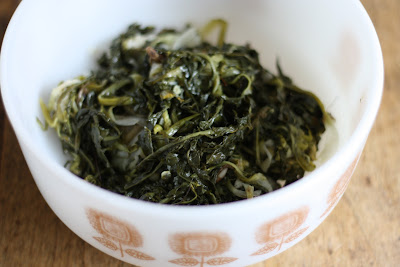
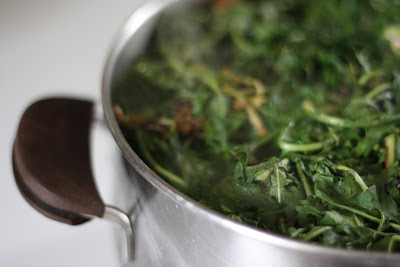
Bring a large pot of water to boil and add the salt. Carefully submerge the greens in the pot and boil gently for about 20 minutes or until the thickest parts of the stems are tender. Do not overcook. Drain the greens well in a colander over the sink. Really squeeze the liquid out with the back of a spoon. Place greens in a bowl and drizzle with olive oil, lemon, salt and pepper. Serve warm or at room temperature.

GREEK BOILED DANDELION
If you are ever driving around on a nice spring day and see a woman bent over in a field with a plastic bag in one hand and a knife in the other, odds are it's a Greek woman picking dandelions for supper.
3 lbs young wild dandelion greens
1 Tbsp sea salt
about 2 Tbsp extra virgin Greek olive oil
the juice of about 1 organic lemon
sea salt and pepper to taste
Method: Wash the greens well before cooking and trim any coarse stems. Discard any brown leaves. Soak the dandelion in a clean sink with plenty of water. Any sand or debris will eventually sink to the bottom while the greens float on the surface of the water. Remove the greens from the water and place in a colander to dry.

Bring a large pot of water to boil and add the salt. Carefully submerge the greens in the pot and boil gently for about 20 minutes or until the thickest parts of the stems are tender. Do not overcook. Drain the greens well in a colander over the sink. Really squeeze the liquid out with the back of a spoon. Place greens in a bowl and drizzle with olive oil, lemon, salt and pepper. Serve warm or at room temperature.
Sunday, January 22, 2012
PLASTIC FREE URBAN FORAGING: A How To Vlog
Despite all the technical difficulties I experienced today trying to get this thing edited, I am pretty happy to share with you what a typical Saturday is like for me. I leave the house as early as possible for a little alone time away from the family and head into the city to shop for supplies. It's been over a year now since I've consciously attempted to drastically reduce the amount of plastic pollution our family generates. It is amazing how much plastic still manages to find it's way into our house even when we try to avoid it like the plague. Along the way I've refined my plastic avoidance skills and thought I'd share some of them with you via this Vlog. I had to edit away alot of footage in order to fit it into the 10 minutes I was allotted by You Tube so I am going to do my best to fill you in on some more details after the video.
VLOG ENDNOTES
Plastic: for more information about why it is important to avoid plastic go here and here
Plastic: for more information about why it is important to avoid plastic go here and here
Bags and Containers: The directions for making your own cotton vegetable bags can be found here
- the same site also has directions for making the simple fabric grocery bags that I show you in the video. The only thing I did differently is sew down the little corner flaps.
- when using glass or stainless steel containers for buying meats, fish and cheeses, simply give the container to the salesperson and they can place it on the scale and tare the weight before adding your purchases to the container
Maple Syrup: We tend to go through a lot of maple syrup and I really wish I could buy it in large quantities in a can like they used to sell it in the good old days. But it appears that most producers are into using the plastic jugs. So, until I find a source for that, I buy the can. Note: many maple syrup bottles are glass and even come with metal caps...
Cart: When shopping at Farmer's Markets I highly recommend a shopping cart that folds up because you will be more inclined to buy a larger percentage of your groceries there if you know you don't have to struggle carrying heavy bags around. Same goes for a cooler - you can relax knowing your precious market goods will be safe and sound in their icy home.
Meat: So after having done a little more research on butcher paper I just discovered that the pink butcher paper is often lined with polyethyene, which is PET (#1) plastic. So, your best bet is to head over to an ethical butcher shop and bring your own containers and/or unlined butcher paper/waxed paper for packaging your meat
Vegetables: The Farmer's Market is your best bet for finding seasonal, local, unpackaged vegetables. Caution though, there is still a lot of over packaging and plastic at the market!
Feta Cheese: I choose the Bulgarian variety because I like it that that Europe generally has higher standards when it comes to food production (like they oppose the use of GMO's) and also because it comes to the store in a can instead of a plastic bucket like the other bulk cheeses. The Mid-East Food Centre is located on Agricola Street in Halifax's North End. They also have an olive bar and bulk food bins.
Planet Organic: also sells bulk medicinal and culinary herbs that can be put into paper bags.
Bulk: I tend to buy flours, grains etc from organic mills in bulk because they come in paper bags. I also buy organic nuts and seeds in bulk even though they come in large plastic bags because sometimes there is no way around it. The way I see it, bulk stores generally fill their bins from plastic packaged goods anyway.
Subscribe to:
Posts (Atom)