Showing posts with label spring. Show all posts

Sunday, February 4, 2018

KUNDALINI YOGA FOR LENT


     I was having a nice conversation with a woman who attends my Sunday yoga class and she mentioned she was considering incorporating a 40 day Kundalini Yoga meditation to mark and honour the Lenten season. I thought this was a lovely idea and thought I'd mention it to you too in case you find this idea appealing as well!

     As a child growing up in a Greek Orthodox family, I annually participated in a traditional Greek lenten period which meant dietary restrictions and fasting. I didn't quite get it at the time, but I am so grateful that I experienced that austere and devotional practice, clearly it had a profound effect on me and has made me the person I am today...
     While it is most common to associate Lent and fasting with Christian (especially Catholic) religions, it is interesting to note that there is a long tradition of spring purification in many faiths and traditions. The very name of Lent is synonymous with the season, for it comes from the Anglo-Saxon lenctene, meaning the time when the days lengthen. If you think about what’s going on in the natural world, these food deprivations make sense. This part of early spring is the most hazardous time of the year for people living close to the earth. The first bitter greens (so prominent a part of spring equinox feasts like Passover and Easter) are just emerging. Fresh eggs, also associated with these feasts, are not yet available; birds are just beginning to nest. The foodstuffs, particularly the salted and smoked meat, that were stored to carry the family through the winter may be giving out. The potatoes and apples left in the cellar are getting soft and of dubious quality. The deprivation of Lent may not be voluntary but a necessity imposed by nature.
     The 40 days of Lent are a significant period. Forty is a magical number which recurs throughout the Bible (Noah floated in his ark for 40 days and nights, the chosen people wandered in the desert for 40 years, Jonah led the citizens of Nineveh through 40 days of penance). But forty is also a "magical" number in the Kundalini Yoga tradtition where it is said that it takes 40 days to break a habit (or establish a new routine).
     But it’s not just the number of days that are significant but their conjunction with the season. In Chinese medicine, spring is the time of the liver, whose energy is change. The sap is rising in the trees, which are budding; the green stalks of crocuses and snowdrops are pushing through the frozen ground. There's an incredible shift happening which — in those parts of the world which are frozen — manifests in the spring thaw, the breaking up of the contraction of winter. Lent is the time for making auspicious changes.
     So, here is what I plan to do ~ for 40 days beginning on Ash Wednesday (by the way I find it interesting that this is the day when priests mark your forehead with a smudge of dark ash  ~ right on the third eye chakra, a place also marked with sacred ash in Hindu devotions!) ~ I'm going to commit to 40 days of Sadhana which means getting up at 5am before the sun rises and doing a Kundalini Yoga kriya and then about 1.5 hours of mantra. For more information on this devotional practice during the ambrosial hours check out this blog post I wrote last year. I also made a You Tube video called "Kriya for Morning Sadhana" which is a really lovely Kundalini Yoga class you may enjoy committing to doing for 40 days. I've also chosen a very special meditation which you might want to practice daily for Lent ~ it is called "The Seven Wave Sat Nam Meditation"
     If the idea of Fasting or Cleansing appeals to you, this could translate to a cleanse or yogic fast. 40 days is a long period of time, so you might choose to spend the first two or three weeks preparing your mind and body, do the fast or cleanse in the middle of Lent, and then spend the remaining period transitioning back to your regular eating habits. Participating in a fast or cleanse can be a powerful opportunity to work on the body, mind, and spirit simultaneously, and would be very appropriate for the Lenten season.  If you don’t feel ready or willing to take on a fast or cleanse, making a commitment to eat better (even once a day or once a week) will go a long way to your physical, mental, and spiritual well-being. 

Whatever you choose to do as the days begin to lengthen as we spiral into spring ~ enjoy the journey!

Friday, April 1, 2016

FEARLESS DETOX

Detox is not as scary as you think!

     In fact, your body is doing it all the time and you're doing just fine. Traditionally the liver and gallbladder are associated with the Spring season, making now the ideal time to enhance liver and gall bladder function. Without strong liver function, detoxification is hindered in the body. Rather than thinking of a detox as something you do to your body - consider it more of a time to support and nourish the organs responsible for detoxifyIng the body (all year round). A healthy detox program emphasizes eating healthy foods and incorporating holistic practices that just make it easier for the digestive and detoxifying organs of the body to move accumulated waste or toxins out, as well as decreasing the toxic burden we generally put on our bodies.    
     After a winter of excess and hibernation, it feels good to switch gears and give our bodies a little attention in the spring. You know how nice it feels to drive your car home after getting a tune-up? The oil is squeaky clean, the fluids have been topped off, windshield wipers have been changes, tire pressure is at that perfect level, and you've vacuumed and washed the car until it shines? Well, just like our cars need some care and maintenance in the spring, so do our bodies.
     Some people freak out at the idea of a spring detox. It's not wonder - there are so many detox kits and programs out there that just scream DEPRIVATION, and I for one have no desire to live without the pleasure of food and eating. Juice fast? Forget it. Master cleanse? No way. I am happy to announce that maintenance does not mean liquid juice fast or maple syrup and lemon juice for days on end.

     As a registered holistic nutritional consultant and yoga teacher, I understand that the best way to support your body in it's effort to keep you healthy is to nourish and support with whole foods, gentle tonic herbs, and invigorating yoga. I've created a 7- Day Spring Detox that is effective and fun to do. There is absolutely no reason to be scared because you will NOT feel deprived. We are going to keep it simple and eat wholesome, delicious foods. The only thing you have to lose is some unwanted poundage, dark circles and puffiness under your eyes, and that feeling of lethargy that has been dragging you down.
     The Spring Detox has everything you will need: a step by step guide, the recipes, a shopping list and meal planner, holistic detox strategies, and yoga videos for vitality and wellness. You are invited to join the program and eat your way to vitality in 7 days!
The Keeping It Real SPRING DETOX E-Course launches on April 10th.
Early Bird Registration is on now - sign up today and save!
Regular Price $40 - You pay just $32 

Monday, March 21, 2016

EASTER CHOCOLATE

     I spent the last month keeping my eyes peeled for the organic chocolate easter bunnies I buy every year for the boys. They were nowhere to be found. I searched online. I had scouts looking in Montreal. I had a tip that a health food store in the city was selling dark chocolate bunnies, but when I showed up hoping they had the milk chocolate versions too I discovered that even the (wax crayon-like) dark chocolate ones were sold out. So in addition to being unable to find organic chocolate easter eggs for our egg hunt (as usual), this year I even had no bunnies.
     It was time to take matters into my own hands. I picked up a stack of organic milk chocolate bars, a fancy new egg shaped candy mould, and some fancy foil wrappers for the eggs. I made my own.
     It's really ever so simple. You melt the chocolate in a double boiler, pour into lightly greased moulds, freeze for a few minutes, then pop them out. 
      Making the eggs was simple too - I just heated a saucepan on the stove, held the flat end of an egg on it until it melted a bit and then pressed another egg onto it really hard until it stuck. I have to say I was pretty darn proud of myself.

     Since I've been on an experimental no dairy, no gluten diet I decided I needed a chocolate treat to celebrate the Spring Equinox too. 
     This here is the one of the BEST desserts ever. I kid you not. 
CHOCOLATE PEANUT BUTTER PIE

Makes a 9" pie or tart pan

Crust:
1/2 cup organic unsalted roasted peanuts
6 Tbsp hemp seeds
3/4 cup coconut 
1/8 tsp sea salt
8 soft dates
1 1/2 tsp vanilla
1 Tbsp maple syrup (optional)


Method: Soak the dates for the caramel layer in hot water while you make the crust. Grease your tart pan or pie plate with coconut oil. Process just the peanuts into a coarse meal in the food processor. Add the hemp seeds, dates, 1/4 cup coconut and the salt and pulse until the dates are incorporated. Add the rest of the coconut, as well as the vanilla, maple syrup, and process until doughy. Press the dough into the pan.

Caramel Layer:
1 cup soft dated (about 11 - soaked in hot water for 15 minutes)
2 Tbsp organic unsweetened peanut butter
2 Tbsp coconut oil
1/2 cup almond or coconut milk
pinch of sea salt

Method: Drain the soaked dates. Puree them in a blender or food processor along with the rest of the ingredients. Spread onto the crust. Place in freezer for 15 minutes before adding the mousse.

Chocolate Mousse Layer:
1/2 cup full fat coconut milk 
2/3 cup dark or semi sweet chocolate chips
2 Tbsp peanut butter
2 Tbsp coconut oil
2 tsp vanilla
1/8 cup maple syrup (depending on how sweet you like it)

Method: Heat coconut milk until it is almost boiling. Pour into a bowl and whisk in the chocolate chips. Then add the rest of the ingredients. Pour onto the chilled caramel. Freeze until set and serve frozen.

Friday, May 15, 2015

DANDELION PESTO with Hemp Seeds and Miso

While most people's lawns are littered with dandelions, mine unfortunately has hardly any.  Which is a real shame because I prize dandelions so very much.  Dandelions are really great for digestion, and as such they help you get even more nutrients from your food.  Dandelion is high in Vitamin A & C, potassium, calcium, iron, phosphorus, B-complex vitamins, as well as other trace minerals. They make a great spring tonic and liver rejuvenator, so be sure to eat a few leaves of dandelion every day to help your body make the transition to springtime. You can add a few leaves to your salad mix, or steam them with your favourite greens. Or you can try boiling dandelion like the Greeks do. This Spring I decided to make a small batch of pesto using some of my precious stash of dandelion greens so I can freeze it and enjoy dandelions all winter long.


 DANDELION PESTO with Hemp Seeds & Miso

3/4 cup organic extra virgin olive oil 
3 cups wild dandelion leaves, washed well
2 cups organic shelled hemp seeds
6 cloves organic garlic, peeled
6 Tbsp organic white mellow miso
4 tsp organic lemon juice or umeboshi vinegar
water as needed to thin

Method: Add all ingredients to the bowl of a food processor and and blend until smooth, adding water as necessary to achieve desired consistency.  


Sunday, June 1, 2014

WHEN THE CAT'S AWAY.....

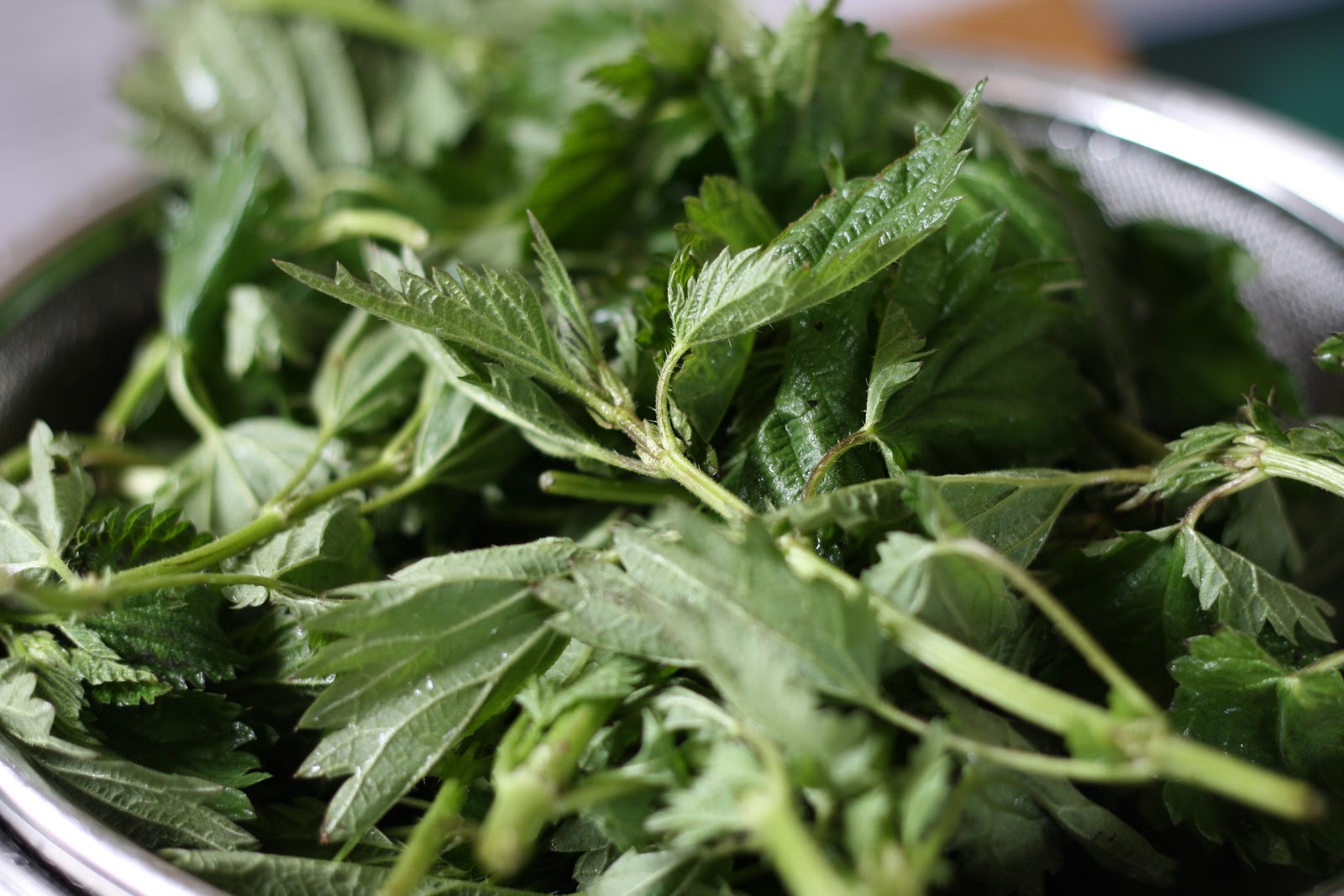
we definitely played.  My dad whisked away my eldest son for a few days, and so my husband and I have been leisurely accomplishing things we never seem to manage to with two kids around.  I harvested some nettle from the garden and made homemade pasta. Seriously good served with a filet of salmon in a balsamic mustard glaze.  I said, "Honey, you know what they say....the way to man's heart is through his stomach....".  A great way to say I love you. 

FRESH NETTLE PASTA with Fresh Tomatoes and Blue Cheese

The idea for using fresh tomatoes and blue cheese came from Hugh Fearnsley-Whittingstall's cookbook Three Good Things.  

1 1/2 cups unbleached organic white flour 
2 cups organic light spelt flour
3 organic eggs, beat lightly
1/2 tsp sea salt
6 cups fresh nettle 

Method: Wash the nettle to remove grit.  Remove leaves from woody stems and place in a pot with 1/4 cup of water.  Bring to a boil and then reduce, steaming until tender - about 4-5 mins.  Drain well and allow to cool.  Be sure to squeeze out excess moisture.  Chop finely.  
In the bowl of a stand mixer add the flour, salt, eggs and nettle.  With the paddle, stir for 1 minute on #2.  Switch to hook and mix for a couple of minutes.  Add more flour if necessary.  Then knead by hand for a couple of minutes.  Allow to rest in a covered bowl for 30 mins.  
     Use a pasta machine to make pasta.

SAUCE:  2 tubs of cherry tomatoes, quartered
1-2 cloves of garlic, sliced
sea salt and pepper
good olive oil

nice wedge of European blue cheese

Method:  Combine all ingredients and allow to macerate for at least 30 mins.  When pasta is cooked, toss with the tomatoes and then crumble on the blue cheese.  Season to taste with sea salt and pepper.  Stir lightly and serve.

SALMON with Balsamic Mustard Glaze

1 nice wild salmon fillet
4 cloves organic garlic, chopped
1 Tbsp organic white wine
1 Tbsp local honey or maple syrup
1/3 cup organic balsamic vinegar
4 tsp organic Dijon mustard
sea salt and pepper to taste
fresh organic oregano, chopped

Method: Preheat oven to 400*.  In a small saucepan combine the garlic, wine, honey, vinegar, and mustard.  Bring to a gentle simmer and cook for about 5 minutes or until it starts to thicken.  Allow to cool and then brush the salmon with half the glaze and sprinkle with chopped oregano.  Bake in oven for 10-15 mins.  Reglaze halfway through cooking time.

Thursday, May 22, 2014

BABY LEEKS AND ASPARAGUS

It will be a couple of years before the asparagus seeds I planted result in any edible spears.  Until then I anticipate the harvest and hope that there are at least a couple of bunches of fresh asparagus left at the market by the time I get there in the morning.  Thankfully today there was, along with some lovely baby leeks.
ROASTED BABY LEEKS AND ASPARAGUS

1 bunch organic baby leeks
1 bunch organic asparagus
2 cloves organic garlic, sliced
2 sprigs of organic fresh thyme
healthy drizzle of organic e.v olive oil
conservative drizzle of organic red wine vinegar
sea salt
organic fresh ground pepper

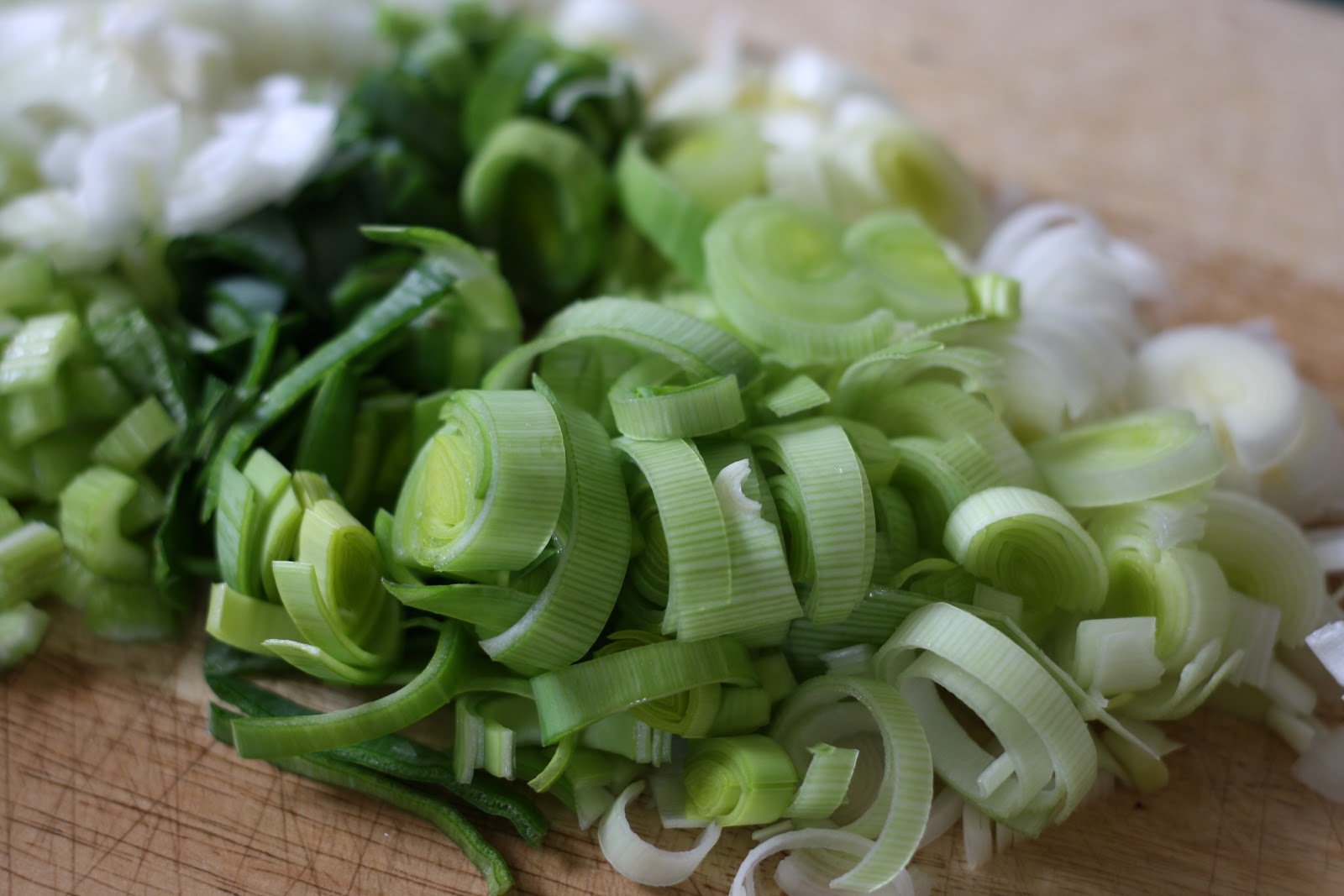
Method:  Preheat oven to 400*.  Remove the tough ends from the asparagus and put in a large bowl.  Wash the leek and then trim both ends of the leeks and then remove one or two of the tough layers from the outsides.  Bring a small pot of salted water to boil.  When ready, remove the pot from the stove and then immerse leeks in the hot water for 3 minutes to blanch.  Remove from the water and drain very well.  Once drained, add the leek to the pot and sprinkle in the fresh thyme, garlic slices, some sea salt and pepper.  Drizzle with the oil and vinegar.  Toss gently to coat in oil.  Spread the vegetables in one layer in a pan, and pour any remaining marinade from the bowl on top.  Broil in the oven for about 10 minutes, watching carefully that the leeks don't burn.

Print Recipe Here

Thursday, April 3, 2014

SPRING SALADS

Weekly trips to the Farmer's Market this time of year always include a stop at the booths laden with fresh salad greens.  Good thing many farmers around here have hoophouses or we'd be in big trouble considering all the snow and cold weather we've been having on the East Coast.  To keep things exciting on the dinner table, I try to make new salad dressings every once in a while.  This creamy, savoury Miso-Tahini Dressing is a definite keeper.
MISO-TAHINI SALAD DRESSING

1/4 cup organic tahini
1/4 cup water
3 Tbsp fresh organic lemon juice
2 Tbsp organic white miso paste
1/2 tsp organic sweet paprika
1 tsp maple syrup
1/4 tsp sea salt

Method:  Put all ingredients in a blender and mix until creamy.

The salad featured in the photos is a mesclun blend with carrot shavings, sunflower seeds, purple sauerkraut, sunflower sprouts, and feta cheese.

Tuesday, July 9, 2013

FORAGED FEAST

     I've felt quite like a bee these days, frolicking in the fields, zig zagging my way round the farm from flower to flower.  It's summer, and the hot sunny days have been the perfect time to collect the wildflowers and herbs that grow on our land.  Once back into the house (which is a cool shady respite from the blazing sun), the herbs are then hung to dry or steeped in vodka, olive oil or apple cider vinegar for various herbal preparations.  The dehydrator has also been getting a workout drying the lovely red clover blossoms that grow in abundance this time of year.  It is such a joy to see my house transformed into an herbal production site - bunches of herbs dangling from the ceiling, sunny window sills and dark cupboards lined with jars of steeping herbs.  There is nothing more rewarding than going outside with an empty basket, and coming back with so many wild herbs.  Mother nature is so great, and provides so much.  There are so many wild plants growing here - and so many more that I can't wait to learn to identify.  


     One plant that I learned about recently is Lamb's Quarters - otherwise known as Wild Spinach.  This plant grows so abundantly in gardens, that most people recognize it as the weed they are always getting rid of.  After having our field plowed this Spring and then planted with Red Clover as a green manure, I was delighted to discover Lamb's Quarters growing, well, like weeds, all over the field.  They especially grow well in the huge pile of composted manure we have up in the corner of the field.  I have been harvesting baskets and baskets of this nutritious plant all week in an effort to stock our freezer full of it for the coming winter.  

     When my husband arrived home last night with a huge container of feta cheese which my mother bought for us, I was inspired to make a pan of Spanakopita with the wild greens.  Lamb's Quarters are a far superior green for this dish for a number of reasons: they taste better, have less water and so yield much more once steamed, and they are free.  What more can you ask for?

     A while back my mother shared her recipe for Greek Spanakotiropita which is the one I always use, only this time I substituted wild Lamb's Quarters for the chard and spinach.  Once you try homemade filo dough, you will never want to use the store bought stuff again.

Monday, May 14, 2012

PLANT OF WISHES AND WINE

We tiptoed barefoot in the grass amongst the dandelions on Mother's Day picking blossoms for wine.  It is difficult for me to comprehend why this so very lovely and useful plant receives such bad press when it magically (and prolifically) appears every spring.  I've noticed quite a few people out fervishly digging them out of their lives with these specially designed tools, which although very odd,  are definitely a better option than spraying with herbicides (poison....did you know anything with "cide" on the end means death?)
Well if you can't beat them, you might as well celebrate them.  And we do, in every way possible.  And what better way than by having a glass of wine that reminds us of Spring on the darkest night of the year?

DANDELION WINE

4 litres boiled water
4 cups dandelion blossoms
2 organic oranges, zest peeled and then juiced
1 organic lemon, zest peeled and then juiced
2 pound local honey
1/4 tsp dry white wine or champagne yeast


Method:  Steep the blossoms in the boiling water, cover and let rest overnight (or up to 3 days) in an earthenware pot.  Then stir in the citrus peels and bring to a boil.  Strain into the earthenware crock again, stir in honey and let cool.  Add the raisins, lemon and orange juice and the the yeast.  Cover loosely and let sit in a dark room or cupboard for 2-3 weeks,  stirring every 2-3 days.  When fermentation is complete, strain with a cheesecloth, and pour into a 4 litre sterilized bottle fitted with a little gadget you buy at the wine making store that lets gas out but no air in.  Let this sit for 3 weeks and then pour into 500 ml bottles and cork.  Let age for 6-9 months.  Enjoy!

Sunday, May 6, 2012

SINGING NETTLES- Soup Revisited

I've planted nettles at every house I have ever owned in the hopes of one day being able to watch it grow into a large healthy plant for harvesting from each spring.  That has yet to happen.  I keep moving before it gets a chance to establish itself.  Luckily I find nettle for sale every year at the Farmer's Market.  I also keep me eyes peeled for wild stinging nettles but have yet to find that special spot where they grow. 
I had fantasies of making Nettle Spanakoptia but having neither the ingredients nor energy to go that route, I opted for my annual pot of Nettle Soup.  Now, I know I've already posted a recipe for making Nettle Soup on this blog, but this recipe is a bit different so worthy of sharing anyway.


NETTLE SOUP Part Deux

150 g organic or wild stinging nettle leaves and tender stems
2 Tbsp organic butter
2 organic leek, cleaned and chopped thinly
1 organic onion
2 cloves organic garlic
2 organic celery stalks, sliced
2 Tbsp organic white or basmati rice
1 litre (4 cups) organic chicken stock
1 handful organic raw cashews, soaked for a few hours in water
1 cup filtered or spring water
sea salt and freshly ground organic black pepper
organic yogurt
fresh chives

Method:  Pick over the nettles, wash them thoroughly and discard the tougher stalks.  Melt the butter in a large pan over medium to low heat, add the onion, leek, celery and garlic, cover and sweat for 10 minutes, stirring a few times until soft.  Add the rice and stock, bring to a simmer and cook for 10 minutes.  Add the nettles, and simmer for 5 minutes or until the rice and nettles are tender.  Season with salt and pepper.  
     Drain the cashew and then place the cashew in a food processor along with the one cup of water.  Blend until completely  pureed into a milk.  Add the soup to blender and puree.  Pour back into the pot, check for saltiness.  Ladle into bowl, top with a dollop of yogurt and snipped chives.  Serve.


Thursday, May 3, 2012

LITTLE STAR LADY

Welcoming spring with open mouths.
The earth is alive, and we have been grateful recipients of her bounty this week.  First it was the dandelions, then the asparagus we've waited three years to feast upon, and today, we relished the freshness of the little star lady, Chickweed.  Stellaria media can easily be overlooked as an unwanted common garden weed.  I myself am guilty of having haphazardly ripped her from the earth in an attempt to clear my garden of unwanted visitors.  
But that was before I realized who this lovely lady was, and there is no going back now.  Oh no, Stellaria media is a definite keeper.  Not only does chickweed taste so fresh and delicious in a salad, it is one of the supreme healers of the herbal queendom.
     Stellaria media is best identified by many small, starry white flowers with five petals than appear to be ten petals.  It grows in low, dense, vibrant-green mats.  Chickweed likes to grow in cultivated/disturbed soil in open but cool environments.  The only spot is grows on my land is in my garden because it's presence indicates fertile, mineral rich soil, and around here that only exists where we've imported or created it (unfortunately).  
Luckily my generous neighbour spotted a bounty of chickweed growing in her garden and invited me over for a little harvesting.

 In the kitchen I clean and prepare chickweed much the same way I do dandelion (check out the deets on my Dandelion Harvest post).  The simplest way to serve dandelion is mixed in with your salad greens and dressed with a simple vinaigrette.  If you want to get a little fancy, use equal parts basil and chickweed in your next pesto, or add a handful to your sandwiches in place of lettuce.  Don't forget, keep your eyes peeled for chickweed when you get out there to weed your garden, and for God's sake, don't throw it out!

Tuesday, April 24, 2012

WEEDING

If you look closely you will see that the dandelion greens are sprouting up everywhere, including in my perennial fruit and vegetable garden.  The whole bed needs to be weeded, and what better way to begin than by harvesting the dandelion greens for supper?  Eating dandelions may seem foreign to many people, but not me.  Growing up in a Greek family means you eat wild dandelion greens every spring.  I have vivid memories of my mother and cousin foraging for dandelions when I was a child, and then serving them for dinner.  They are definitely an acquired taste, and luckily I have that.  The bitterness of the dandelion is a powerful spring tonic for your digestive system, stimulating your liver to detoxify.  Which is a really good thing after a long winter of heavy foods.
I remembered to grab my camera on my way out the door yesterday morning so I could show you how I harvest spring dandelion greens.  When you are ready to try this yourself, just be sure you pick them in clean and unpolluted areas.  That means no digging for dandelion on the side of the road!  As tempting as that may be, it is a really bad idea.  Which is too bad because dandelions love to grow on the gravelly soft shoulders of roads.

GREEK BOILED DANDELION

If you are ever driving around on a nice spring day and see a woman bent over in a field with a plastic bag in one hand and a knife in the other, odds are it's a Greek woman picking dandelions for supper.

 3 lbs young wild dandelion greens
1 Tbsp sea salt
about 2 Tbsp extra virgin Greek olive oil
the juice of about 1 organic lemon
sea salt and pepper to taste

Method:  Wash the greens well before cooking and trim any coarse stems.   Discard any brown leaves.  Soak the dandelion in a clean sink with plenty of water.  Any sand or debris will eventually sink to the bottom while the greens float on the surface of the water.  Remove the greens from the water and place in a colander to dry.

Bring a large pot of water to boil and add the salt.  Carefully submerge the greens in the pot and boil gently for about 20 minutes or until the thickest parts of the stems are tender.  Do not overcook.  Drain the greens well in a colander over the sink.  Really squeeze the liquid out with the back of a spoon.  Place greens in a bowl and drizzle with olive oil, lemon, salt and pepper.  Serve warm or at room temperature.

Monday, April 16, 2012

KIDDING AROUND

So fun to wake up this morning, look out Faegan's bedroom window into the backyard and see Scott still home and striding across the lawn.  Hooray!  he was so happy to announce that our sweet goat Cassie had given birth to two kids.  
What an exciting moment for our family, this being the first birth we've experienced as new farmers.  Not only are we blessed with two very cute little kids, we will soon be in the milk as well which is great because I miss having access to organic, raw milk.  Guess I better brush up on my milking skills, and my enthusiasm for this daily task.
   Before I keep gushing about his wonderful event, I must fill you in on the circumstances which led to this joyous occasion.
     So our little brood of goats arrived at Spruce Hill Farm way back last spring as a threesome, Cassie and her two kids whom we named Buck and Nola.  Now Buck was the male and he was still a youngster, but we knew we had to keep an eye on him as he matured so that he wouldn't try and mate with his mommy or sister.  Time passed and so eventually did Buck.  As late winter rolled around we made arrangements with a local farmer to have our Cassie date her buck for a little while in hopes of getting her pregnant.  Time passed there as well and no luck hooking those two goats up no matter how long we left her there!  So, we disappointedly brought Cassie home, only to discover that she was already pregnant, very pregnant too.  Looks like Buck left a little of himself behind...
     Apparently this is deemed a "terminal cross" which isn't a problem genetically unless it unexpectedly happens again within the family.  Which could very well happen because I think we have two new boys in the family.

Friday, March 16, 2012

EATING IRISH (Soda Bread)

One of the things I like most about being a parent is revisiting stories, traditions, and cultural concepts that I was exposed to as a child.  For the most part I am learning so many new things about things I thought I knew about, but I am also sometimes aghast at the things children are taught in books and in the mass media.  One of my favorite books as a child was the Little House on the Prairie series by Laura Ingalls Wilder.  Reading them again as an adult each night with my son has been wonderful. Well it was until I got to the second book that tells the tale of the Wilder family moving to the prairies and essentially stealing land and resources from the Native Americans.  I never realized what a stereotypical and racist slant the book has.  I had to censor the story as I was reading it out loud, which was really hard because they go on and on about it.
So this week I've been reading all kinds of story books about Leprechauns and clover.  I'm not all that much interested in St.Patrick, but I do love the tales of the wee folk and the fauna.  So while I always knew that Leprechauns were little green guys, I didn't realize they were the cobblers to Faeries.  In one of the story books a man named Finn raves on about his mother's soda bread so much that I had a huge craving for some myself.
Last night before I went to bed I whipped up a batch of dough to ferment a bit overnight before I baked a loaf this morning.  I'm in love.  So, if you're feeling like a little Irish spring celebrating at this time of year, do yourself a favour and bake a loaf of this Soda Bread.
SPELT IRISH SODA BREAD

1 1/2 cups organic whole grain spelt flour
1 1/2 cups organic light spelt flour
1/2 Tbsp sea salt
1/4 cup organic coconut sugar
1 tsp baking soda
1/4 cup organic rolled oats
6 Tbsp organic unsalted butter
1 cup organic buttermilk

Method:  Place a pizza stone in the oven and preheat to 375*.  In a bowl, stir to combine the flours, oats, salt, and sugar.  Cut in the butter and then Stir in the buttermilk, cover, and allow to sit at room temperature overnight.  In the morning, sift in the baking soda, knead it into the dough a bit .  Form the dough into a round loaf and make an X with a knife on the the top of the loaf.  Place the loaf on the preheated stone and bake for about an hour.  Set on a rack to cool.
(ps Normally Soda Bread is made by mixing all the ingredients just before you are going to make it, so the baking soda would be stirred into the flour before adding the buttermilk.  While doing this does make it easier to evenly incorporate the baking soda into the dough, it prevents you from being able to soak the flour overnight in buttermilk....)

Sunday, March 4, 2012

DIGGIN IT SUNDAY * 03/04/12

I love Sundays.  We start the morning off with a big family breakfast, and then everyone gets a chance to "get stuff done" around the house while Jude sleeps.  More often than not, this means Scott and Faegan are outside building or doing other chores, and I am inside, cleaning house, cooking, sewing, or just having some alone time in the house picking my nose.
Scott and Faegan were outside all day making an honest to goodness, real, functioning cold frame.  Last year we sort of built one into our garden, but it kind of sucked.  After reading the awesome book The Year Round Vegetable Gardener by Nikki Jabour, which was written by a local gardener, we were inspired to get serious and think about a structure that could help feed us all year long.  I am crazy excited about the idea of growing greens at times of the year when you least expect it.  Like in the middle of winter, and well,  right now for instance.  Especially after I just spent $5 on a tiny bag of fresh spinach at the market this weekend which made one salad for supper tonight  Now all we need is a year round indoor location for our grow lights.......
What's this?  Forsythia in March?  Mais oui!  Ok, so I cheated and forced some branches indoors last week.  It is so nice to see flowers blooming at this time of year when it feels like winter will n e v e r end...........sigh.   But it is ending, I can feel it in my bones and see signs of spring everywhere.
I can't leave this diggin it sunday without mentioning how much I loved Faegan's imaginative play this week.  As I was putting Jude down for a nap I heard his little feet running back and forth downstairs.  When I came down he has this beautiful spread laid out on the coffee table.  He said it was a birthday feast for me (hmm, it's not my birthday, but I can pretend it is....)

Friday, May 20, 2011

LIFE ON THE LAND

Spring is such an exciting time of year.  Each day brings new delightful discoveries on the land.  I am especially enjoying witnessing the asparagus  I planted last year find their way out again.  Although they are not ready to eat this year, already they are looking like the real thing!  I was also pleasantly surprised to locate fiddleheads unfurling all around our land, poking their heads out of the moss.  The garden is being planted, a little more each week, and I can't wait until the seeds we sowed start to sprout.  I love going out each day and checking in on all the gardens to see what's happening!  Life is good.
Some dandelion leaves I picked from our yard.  I made a lovely Dandelion Vinegar with some of the leaves.  The rest we ate in fresh salads or boiled and then drizzled with lemon juice, olive oil, sea salt and pepper.
Our new little chicks in the tanning room.
The new turkeys are catching some rays too.
Lovely fiddleheads abound.
Garlic is one of my favorite things to grow.
Scott's very organized garden markers.
Our new homemade cold frame.
The rhubarb appears to have survived the winter.
As did the strawberry plants.
My delicate currant bush.
Bergamot.
One of my favorite herbs for tea in the summer - Lemon Balm.
Tarragon.
Prolific oregano.
Healing comfrey.
Cute little parsley.
And my lavender came back!

Sweet blessings from the earth.  Happy Spring!